


Mate Gourd: 5 Signs of a Quality Piece
 Alexis · Founder of YVY Maté
Updated on
4 min read

Key takeaways
- A good mate gourd comes from southern Brazil and its wall is at least 1.5 cm thick
- The rim should follow the gourd and the leather as closely as possible, with no visible gap between them
- The leather is stitched and firm, and the finest gourds arrive pre-cured, their interior already smooth
- Well cared for, a quality mate gourd lasts a lifetime and can be passed on
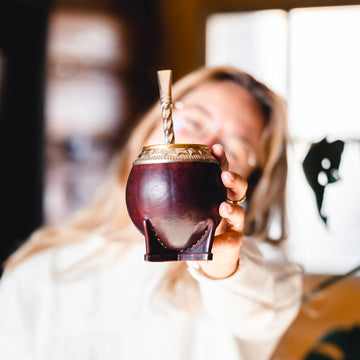
A quality mate gourd stays with its owner for years, sometimes a lifetime. In a photograph, though, they all look alike: a gourd, a leather sleeve, a metal rim. What sets them apart comes down to five details that are quickly learnt, and that guide every choice we make at YVY.
You can find natural mate gourds from €25. We have chosen not to offer them. At that price the quality is poor, and poor quality is always paid for twice: once when you buy, and again the day you have to replace it. Our gourds are for those who would rather choose once, and choose well.
If you are still deciding between natural gourd, wood and stainless steel, our guide to choosing your mate gourd will help you settle it. This article is about the traditional mate gourd, a natural gourd sheathed in leather, with a few words on wood for those just starting out.
The thickness of the gourd, the first sign of a quality mate gourd

Everything starts with the gourd. A good mate gourd comes from southern Brazil and its wall is at least 1.5 cm thick. A thinner wall is more fragile. It copes less well with repeated curing, and its lifespan is markedly shorter. It can break at the first knock against the edge of the sink, and when it does not break, it ends up cracking.
You feel thickness before you measure it. A thick gourd has weight and density, where a thin one seems light, almost hollow. Every gourd we use meets this 1.5 cm minimum. It is our first selection criterion, and the reason you need not worry about it when ordering from us.
Origin, variety and shape
That thickness owes nothing to chance. It depends on where the gourd comes from and on its variety. The thickest gourds take longer to grow and, above all, they are rarer.
Then comes the shape. Lesser gourds can be recognised in profile by their narrow opening and their very bulbous base. You notice it in daily use: the mound of yerba is harder to form, curing is trickier, and these gourds often have a wall of barely 0.2 cm.
A fine gourd has a generous opening and a balanced body. We ask our craftsman to keep only the best shapes, whether the gourds are destined for our Torpedo, Camionero or Imperial models. This choice has a cost that we accept: our stock is limited, because few gourds meet these criteria. This standard was not set in a day. We built it with him over the years, piece after piece, to serve you as well as we can.
The fit of the rim and the choice of metal

The rim is the band of metal that crowns the gourd. Look at the point where it meets the gourd or the leather, depending on the model. On a carefully made piece, the metal follows the gourd and the leather as closely as possible. When a gap appears between the two, the fitting has been neglected, and the wider the gap, the less care went into the work.
Next, the metal can be told by its colour. Aluminium is dull, with no lustre. Alpaca, the silvery alloy of South American tradition, has more presence and develops a patina over the years. Stainless steel does not oxidise and keeps the same appearance over time. Silversmith-grade alpaca, lastly, denser and purer, stands out for its pronounced silver colour and does not oxidise, or only very slightly. Depending on the model, our rims are made of stainless steel, alpaca or silversmith-grade alpaca, and each product page says which.
Genuine leather, stitched and firm

Fine leather is stitched, and the stitching shows. On lesser gourds it is simply glued.
How the leather holds matters just as much. Many gourds stand on leather feet, which must be solid and sturdy. Soft feet betray average, sometimes poor leather.
Then there is the smell. Genuine leather has a scent everyone recognises, and that imitation leather will never have. It is often the first thing you notice on opening the parcel.

A smooth interior, already pre-cured
The finest gourds arrive pre-cured by the craftsman. Their interior is already smooth and there is nothing to scrape. All that remains is to prepare them with your yerba, and four to six hours are enough for the smoothest of ours. Our curing guide explains how to go about it.
Some enthusiasts like raw gourds, and that is a matter of taste. Preparing them simply takes longer and more care, since they have to be cured over several days.
To start out, a carob wood mate gourd at €35
There is no need to begin with a leather-sheathed gourd. Our Camionero carob wood gourd, at €35, is ideal for starting out. The craftsmanship is excellent, with a closely fitted stainless steel rim. It simply calls for fewer noble materials than a gourd dressed in leather, which explains its price.
The rule of thickness applies to wood too, which needs to be at least 1 cm thick to last. A thinner wooden gourd is still usable, but it is more fragile and will not be made for life.
When the mate gourd becomes a work of art
Beyond these criteria another realm begins, that of art. The talent of certain craftsmen gives rise to exceptional gourds. Chiseling on wax, the most complex and the longest of the techniques, allows embossing of great finesse, to which are added bronze and other ornaments made by hand.
Our most accomplished pieces reach €349. At that level, you are acquiring a true work of art far more than a gourd for drinking mate. You would almost want to keep it untouched.
Frequently asked questions
Does a quality mate gourd need curing?
How can you tell the different rim metals apart?
How long does a good natural mate gourd last?
How thick should a mate gourd be?
What does a quality mate gourd cost?
Natural gourd or wood: which mate gourd should you choose to start with?
Want to taste an exceptional organic mate?
Discover our yerbas, sourced directly from our partner growers committed to agroforestry, and certified organic.
Discover our organic mateRead next

Starting Mate: Which Mate to Choose for Your First Time?

Wooden Mate Gourds (Carob, Palo Santo): The Guide to Proper Curing
