

What is the composition of yerba mate? Caffeine, antioxidants, and vitamins
 Alexis · Founder of YVY Maté
Updated on
2 min read
Alexis · Founder of YVY Maté
Updated on
2 min read

Key takeaways
- Our lab analyses measure 1.3 g of caffeine per 100 g of leaves
- Theobromine and theophylline, two cousin alkaloids, round out the stimulation
- Polyphenols and antioxidants dominate the profile — more than in green tea
- B and C vitamins, potassium, magnesium and zinc complete the picture
Mate is often presented as a natural energizing drink. But beyond its stimulating effect, what does mate really contain?
Behind its dried, finely cut leaves lies a rich composition: caffeine, theobromine, antioxidants, vitamins and minerals.
Let's discover together what makes this traditional South American infusion far more than a mere pick-me-up.
A natural stimulant, better balanced than coffee
Our lab analyses show our yerba mate holds on average 1.3 g of caffeine per 100 g.
That's, on average, as much as coffee, but three to four times more than green tea.
Even more surprising: mate's caffeine acts differently!
Thanks to naturally present tannins, it's absorbed more slowly by the body, delivering a tonic effect both steady and lasting, without the sharp spikes you can feel with coffee.
No sudden spike, no abrupt energy dip: the effect is diffuse and balanced.
Add to that theobromine, another alkaloid found in cocoa, which supports circulation and mental clarity.
| Drink | Average caffeine (g/100g) | Main effect |
|---|---|---|
| Coffee | 1,3g | Fast stimulation, short-lived |
| Mate | 1,3g | Smooth, steady energy |
| Green tea | 0,4g | Light relaxation, mild stimulation |
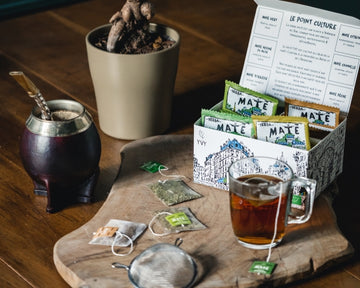
By way of comparison, 10 g of coffee goes into a 200 ml cup. We recommend 20 to 30 g of mate for a gourd (around 1L brewed) and 10 g of mate in an infuser (around 420 ml).

A traditional 200 ml mate
A high antioxidant content, nature's true protectors
Mate is particularly rich in antioxidants, mainly polyphenols, also found in green tea, grapes and cocoa.
These natural compounds help neutralize free radicals, unstable molecules produced by stress, pollution or an unbalanced diet.
In excess, these free radicals speed up cellular aging and encourage certain chronic inflammation.
Studies have shown mate contains more antioxidants than green tea.
It also contains saponins, natural molecules with anti-inflammatory and immune-supporting properties, which take part in the digestive system's regeneration.
In short, beyond its stimulating effect, mate acts as background natural protection - a drink that supports both body and mind, day after day.

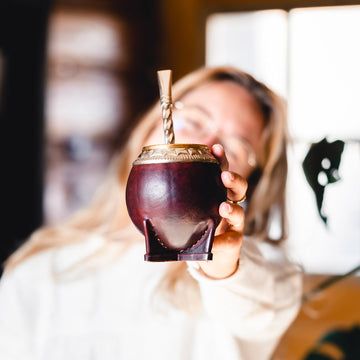
Tropical mate in a gourd
A concentrate of vitamins and minerals
Mate leaves hold a fine diversity of natural micronutrients:
- B vitamins (B1, B2, B3, B5) for energy and metabolism,
- magnesium and potassium for nerve and muscle balance,
- iron for oxygen transport,
- zinc and manganese for the immune system.
All with no added sugar, no additives: simply what nature gives the plant.
A composition that varies with origin and preparation
Mate's richness varies with its terroir and its processing methods.
The Brazilian mates we select at YVY are unsmoked, which preserves the antioxidants and the leaves' natural flavor to the fullest.
Argentine mates, often smoked, develop a smoky, woody aroma; they retain many polyphenols too, but the sensory and nutritional profile can differ slightly.
Even the water temperature influences the composition: above 80°C, some sensitive molecules break down. The ideal temperature sits around 70°C to 80°C. For more information, see our article how to prepare mate properly.

A mate plantation in Brazil
Why YVY mate's composition is unique
At YVY, we work with the finest growers of southern Brazil, renowned for their terroir and their agroforestry farming, certified Organic and Demeter.
The trees shield the crops from the sun, encouraging slower growth and varied biodiversity, letting the leaves naturally develop a richer aromatic palette.
Our mate is dried indirectly, with no smoke contact and no added flavoring, preserving all its purity and unique flavor.
To find this composition in your cup: our Organic Green Mate in 1 kg, the Buenos Aires for lovers of character, or the Tropical Mate on the fruity side.
Frequently asked questions
How much caffeine does mate contain?
Which active compounds does mate contain?
Does the composition vary from one mate to another?
Want to taste an exceptional organic mate?
Discover our yerbas, sourced directly from our partner growers committed to agroforestry, and certified organic.
Discover the shopRead next

Starting Mate: Which Mate to Choose for Your First Time?

Wooden Mate Gourds (Carob, Palo Santo): The Guide to Proper Curing
