


Buying Guide: How to Choose Your Mate Gourd
 Alexis · Founder of YVY Maté
Updated on
4 min read
Alexis · Founder of YVY Maté
Updated on
4 min read

Key takeaways
- Squash is the traditional gourd: it improves the taste but requires curing
- Wood, ceramic and stainless steel skip the curing: perfect for starting out hassle-free
- Count on 200 ml for solo use, up to 250 ml for long sessions
- Well maintained, an artisan gourd stays with you for years, sometimes generations
Many mate cups are available to buy in France and Europe, of varying quality.
So, how do you choose your mate cup well? How do you find high-quality gourds?
Stainless steel mate gourds
These are the most affordable mate gourds on the market.
These gourds are produced in China - today the only country that has kept factories able to produce quality stainless steel gourds, thermoses and mate cups.
They're very easy to find in most mate shops.
There are, however, stainless steel mate gourds from South American manufacturers at slightly higher prices, but with a guarantee of superior quality. These stainless steel gourds are wrapped in leather to keep an artisan, traditional look.
We exclusively offer the stainless steel gourd models made by Tempera.
How are they made?
Factory-made, a stainless steel gourd is simple to produce: all it takes is a base mold and stainless steel to manufacture in large quantities.
Most often, they come with a double wall to prevent burns and retain heat.
Pros and cons
This mate cup is popular with drinkers who want to start drinking mate from a gourd.
It is very affordable, easy to care for and sturdy. Being steel, the gourd needs no curing.
On the downside, we've noticed the well is harder to form. With smooth walls, the yerba mate grips less.
Without the well, the brewing of the mate leaves isn't controlled and the yerba's intensity comes out stronger.
Finally, the stainless steel cup is not artisan-made. These gourds are very useful for drinking on the go, at the office or for tereré. Unfortunately, they don't offer all the taste subtlety of a squash gourd.
Squash mate gourds: artisan and traditional
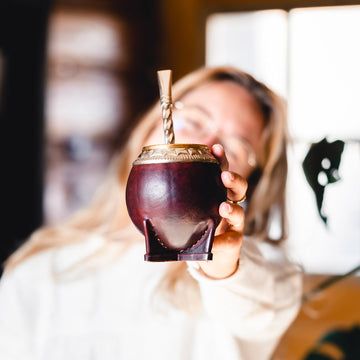
Natural artisan gourds come from the squash, a fruit of the cucurbit family!

A squash growing
The farm work
The farm work begins with harvesting and selecting the squashes in South America. You need squashes suited to mate drinking - neither too big nor too small.
The shape and thickness of the squashes matter, and gave rise to several gourd types: Torpedo, Imperiale and Camionero.
After harvest, the squashes are emptied and dried for 6 months, then selected before the artisan work begins.

Drying the squash
The artisan work
The craftsmanship starts with fitting the feet and the leather.
The feet keep the gourd upright, and the leather - on top of the wall thickness - helps insulate it from the hot water.
Aesthetics are part of the mate gourd craft too. Artisans usually add a band (virola) around the "boca", the opening of the mate cup.
The band can be made of stainless steel, Alpaca, bronze, silver or even gold!
Engravings can also be added, on the leather or the band.
You can discover these mate gourds in our shop

The artisan work behind a gourd
Pros and cons of artisan mate gourds
Making a squash mate cup takes a long time - up to 2 years for the biggest gourds, counting growing time. That makes it rare and harder to come by than the steel gourd.
The natural gourd requires special attention before your first mate: it must be cured.
Curing protects your gourd: the tannins in the mate create a protective layer and also improve your mate's flavor.
For more information on curing a gourd, take a look at our blog article.
In addition, gourd care, though very simple, is necessary.
Be sure to empty the yerba mate from the cup and rinse it with hot water after every use.
What we love about the squash gourd are the values it reflects. It lets us travel to South America for a brief moment, through its traditional way of drinking mate and its originality.
It also brings extra flavor to the mate thanks to the tannins bound to the gourd's walls, accentuating the taste of the yerba mate.
Among our most popular artisan models: the engraved Torpedo and the Torpedo with stainless steel band.
Artisan mate gourds in wood, glass or ceramic
There is a way to combine the easy care of stainless steel or ceramic with a love of craftsmanship and quality work: artisan ceramic mate gourds.
These gourds need no curing or upkeep, while looking like the spitting image of a traditional gourd!
These are the gourds we recommend to anyone hesitant to dive into the adventure of a traditional squash gourd!
Another way to enjoy mate traditionally without curing the gourd or worrying about upkeep: wooden mate gourds.
These gourds are accessible, letting you discover the mate tradition at a lower cost while keeping an artisan look. Our wooden gourds are made from jujube wood.
The wood grain is different on every piece, and its small capacity (120 ml to 150 ml) makes for small mates - perfect for mornings and newcomers.
You'll find everything you need - a wooden gourd, a classic bombilla and 500 g of our organic mate - in our discovery mate kit, available for just €39.
Frequently asked questions
Which mate gourd should you choose as a beginner?
What is the difference between a calabash and a wooden mate gourd?
How much does a good mate gourd cost?
Want to taste an exceptional organic mate?
Discover our yerbas, sourced directly from our partner growers committed to agroforestry, and certified organic.
Discover the shopRead next

Starting Mate: Which Mate to Choose for Your First Time?

Wooden Mate Gourds (Carob, Palo Santo): The Guide to Proper Curing
